
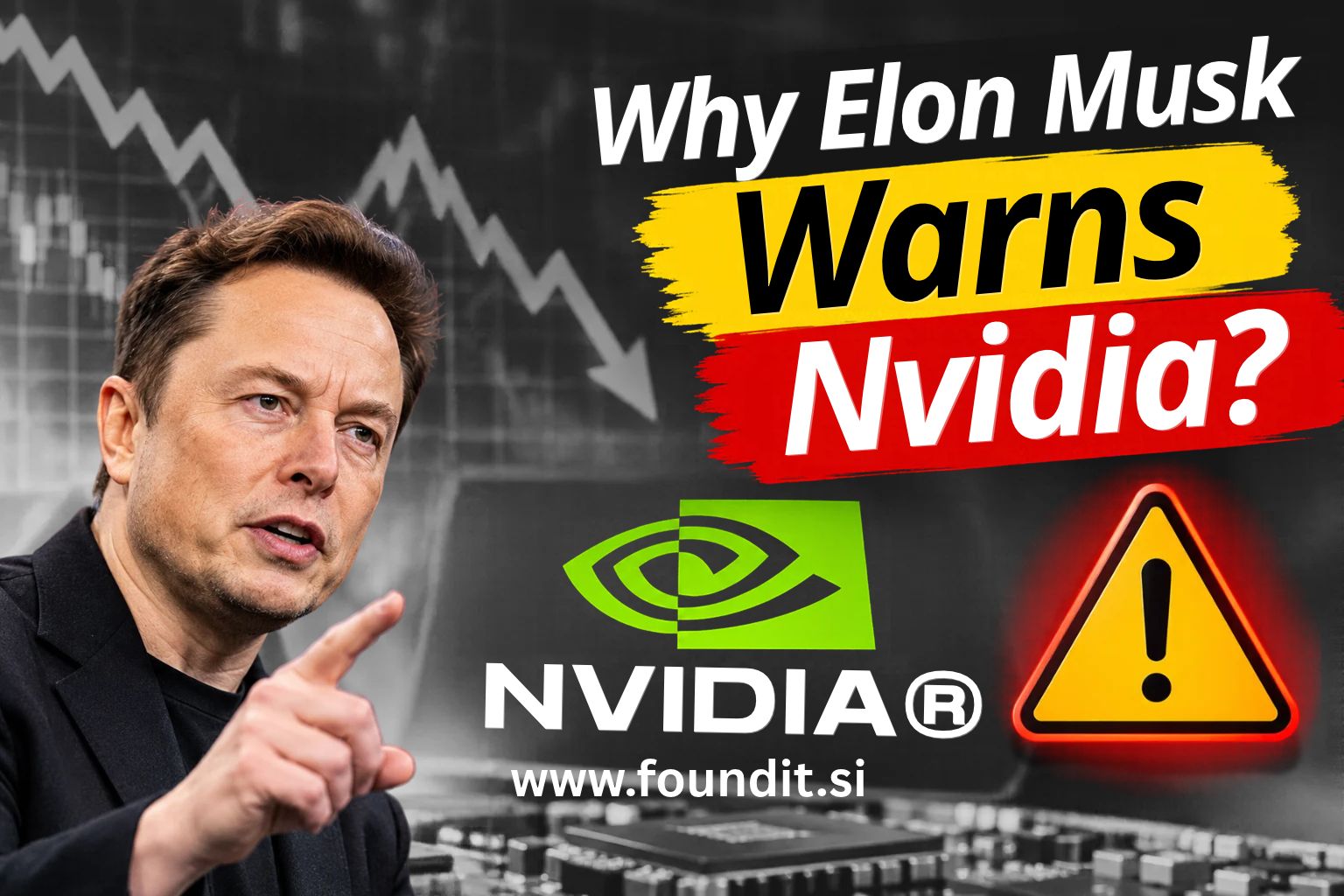
Why Elon Musk Warns Nvidia? Nvidia’s success is not just about powerful AI chips. It is also about the relationships, trust and business partnerships built by CEO Jensen Huang over several decades. A growing discussion around his leadership highlights an important question: What happens to Nvidia’s critical supply chain relationships if Jensen Huang is no longer at the company?
The key concern is that some important business relationships may depend not only on formal contracts but also on personal trust and handshake agreements with Jensen Huang. This raises an interesting point about corporate leadership, business negotiations and the long-term strength of Nvidia’s position in the artificial intelligence industry.
What Happened? Elon Musk Raises Questions About Nvidia’s Future
On November 14, 2026, Elon Musk commented on Jensen Huang’s departure from Nvidia through a post on X (formerly Twitter). Musk praised Huang’s ability to manage Nvidia’s supply chain and explained that several important business arrangements were based on personal trust rather than traditional written agreements. According to Musk, Huang had built strong relationships with suppliers and business partners. These relationships helped Nvidia secure important components and maintain reliable supply arrangements. Musk warned that some of these deals could be lost following Huang’s departure. Career Opportunities in Artificial Intelligence: Top AI Jobs in 2027
His comments came after Nvidia announced a leadership transition on November 12, 2026. The company confirmed that Huang had resigned as President and CEO with immediate effect. Nvidia appointed its Chief Financial Officer, Colette Kress, as interim CEO while the board begins searching for a permanent replacement. NVIDIA Newsroom+1 This development has raised questions about whether Nvidia can maintain its supply chain strength without the executive who helped build many of its important industry relationships.
Why Jensen Huang Was Important to Nvidia’s Supply Chain
Jensen Huang co-founded Nvidia in 1993 and led the company for more than three decades. During this period, Nvidia transformed from a graphics chip manufacturer into one of the world’s most important companies in artificial intelligence and accelerated computing. However, Nvidia’s growth was not driven by technology alone. The company also needed a strong network of suppliers, manufacturers and technology partners to produce its advanced processors.
Modern AI chips require several specialised components, including:
- Advanced semiconductor wafers.
- High-bandwidth memory (HBM).
- Advanced chip packaging.
- Semiconductor substrates.
- Cooling and power infrastructure.
- High-performance computing components.
These components come from different companies and regions. A delay in even one important component can affect the production and delivery of complete AI systems. Huang understood the importance of these relationships and reportedly worked directly with suppliers to secure production capacity for Nvidia. His approach involved more than placing orders. It also involved building confidence among suppliers about Nvidia’s future requirements.
According to comments highlighted in the discussion shared by Musk, semiconductor analyst Dylan Patel described how Huang personally approached even smaller suppliers to secure capacity for components that could become important in the future.
What Does Musk Mean by ‘Handshake Deals’?
The term handshake deal refers to a business understanding based on mutual trust and personal commitments. In a traditional business agreement, two companies sign formal contracts that explain pricing, delivery schedules, quantities and other conditions. However, some business relationships also involve informal commitments before the final paperwork is completed.
Musk’s argument is that certain Nvidia suppliers may have agreed to support the company because they trusted Jensen Huang personally. He also described his own experience working with Huang. Musk said that when Huang promised computing capacity or agreed to accelerate component deliveries, he consistently followed through.
This kind of reliability can become extremely valuable in industries where demand is high and production capacity is limited. However, it is important to understand that Musk’s statement is an assessment of the potential risk. It does not establish that Nvidia has already lost these supplier agreements.
How Nvidia Could Be Affected by Jensen Huang’s Departure
Nvidia’s leadership transition comes at a time when demand for AI computing infrastructure remains a major factor in the semiconductor industry. Companies developing artificial intelligence models and data centres require powerful processors, memory and networking equipment. If some suppliers have stronger personal relationships with Huang than with Nvidia as an organisation, the company may need to work harder to maintain those relationships.
Here are some possible challenges.
| Potential challenge | Possible impact on Nvidia |
|---|---|
| Supplier relationship changes | Some suppliers may reconsider existing business commitments |
| Production capacity | Competitors may compete for limited manufacturing capacity |
| Component availability | Delays could affect chip and system deliveries |
| Customer confidence | Large customers may seek greater supply certainty |
| Leadership transition | New management must maintain supplier confidence |
These are potential risks, not confirmed business losses.
1. Suppliers Could Give More Attention to Competitors
Nvidia operates in a competitive semiconductor market.
Companies such as Google, AMD and other technology businesses are developing their own AI hardware and competing for manufacturing resources.
If Nvidia’s relationships with certain suppliers become weaker, competitors could try to secure more production capacity.
This could become important for specialised components that cannot be produced quickly or easily.
2. Production Planning Could Become More Difficult
Semiconductor manufacturing requires long-term planning and significant investment.
Suppliers need confidence that customers will purchase the components they produce.
Huang’s ability to communicate Nvidia’s future requirements may have helped suppliers plan their production capacity.
The new leadership will need to maintain the same level of communication and confidence.
3. Nvidia May Need to Build New Leadership Relationships
A CEO transition does not automatically end corporate partnerships. Nvidia has experienced executives, engineering teams, procurement professionals and established business operations. However, the new leadership must demonstrate that the company’s commitments remain reliable even without Huang personally managing every important relationship.
Who Will Lead Nvidia After Jensen Huang?
Colette Kress | NVIDIA Newsroom
Following Huang’s resignation, Nvidia appointed Colette Kress as interim CEO.
Kress has served as Nvidia’s Executive Vice President and Chief Financial Officer since September 2013. She has extensive experience in financial management, corporate planning and business operations. Her appointment provides temporary leadership continuity while Nvidia’s board searches for a permanent CEO. The major challenge for the new leadership will be to maintain the company’s existing business relationships.
The next CEO will need to focus on:
- Maintaining trust with key suppliers.
- Protecting existing manufacturing agreements.
- Securing future component supplies.
- Supporting Nvidia’s AI chip development.
- Maintaining customer confidence.
- Preserving Nvidia’s competitive position.
The leadership transition will therefore be about more than appointing a new CEO. It will also test whether Nvidia’s business relationships can operate independently of its founder.
Why Nvidia’s Supply Chain Is So Important for the AI Industry
Nvidia has become a major supplier of GPUs used in artificial intelligence training, data centres and high-performance computing. Its products are used by cloud service providers, technology companies, research organisations and businesses developing AI applications. PHP Hack?
The production of advanced AI processors depends on a complex global supply chain. For example, companies such as Taiwan Semiconductor Manufacturing Company (TSMC) play an important role in advanced semiconductor manufacturing, while memory and packaging suppliers provide other essential components.
Nvidia has also announced plans to expand its supply chain capacity. In a recent company announcement, it discussed increasing substrate capacity and working with manufacturing partners to support future AI infrastructure demand. This explains why supplier relationships are strategically important. Even if a company has advanced chip designs, it cannot meet customer demand without sufficient manufacturing capacity and access to essential components.
Could Google and AMD Benefit From Nvidia’s Leadership Change?
Nvidia’s competitors could potentially benefit if the leadership transition creates uncertainty around its supplier relationships. Google is developing its own AI chips, including Tensor Processing Units (TPUs), while AMD is competing in the AI accelerator market. Both companies have reasons to secure reliable manufacturing and component supplies.
If suppliers have additional production capacity, competing technology companies may try to reserve it for their own products. However, Nvidia’s market position cannot be judged only by its relationship with one executive. Its technology, software ecosystem, customer relationships, engineering capabilities and existing commercial agreements also contribute to its competitive strength. Therefore, it would be premature to conclude that Google or AMD will automatically gain market share because of Huang’s departure.
What Does This Mean for Nvidia Investors?
Elon Musk’s comments have added another dimension to the discussion around Nvidia’s leadership transition. For investors, the important question is whether the company can maintain its operational performance during the transition.
Investors may want to monitor the following developments:
| Important factor | What investors should monitor |
|---|---|
| CEO succession | Permanent CEO appointment |
| Supplier relationships | Updates on manufacturing partnerships |
| AI chip production | Production capacity and delivery schedules |
| Revenue growth | Quarterly financial results |
| Competition | Developments from AMD and Google |
| Management strategy | Future investment and expansion plans |
Investors should avoid making decisions based only on social media comments or speculation. Musk’s warning highlights a potential business risk, but it does not confirm that Nvidia’s supply chain is breaking down. The company’s upcoming announcements, financial reports and management decisions will provide more useful evidence about its actual business position.
Final Takeaway on Elon Musk Warns Nvidia
Jensen Huang’s departure represents a major leadership change for Nvidia. Elon Musk’s comments highlight an important lesson about modern business: strong companies are built not only through technology and financial resources but also through trust, credibility and long-term relationships. Huang’s personal involvement in supplier negotiations may have provided Nvidia with advantages that are difficult to measure through traditional financial statements.
However, Nvidia is more than one individual. Its technology, workforce, business partnerships and manufacturing ecosystem remain important parts of its operations. The biggest test for the company will be whether its new leadership can preserve the trust Huang built and continue securing the components needed to support the global AI industry. For Nvidia, the next chapter will show whether a business empire built under one powerful leader can maintain its strength under new management.